Start Well: The Essential Foundations
Knife Skills for Home Cooks
Build a calm cutting routine with a stable board, comfortable grips and consistent slices, batons and dice.
In this guide
Good knife work makes cooking easier long before it looks impressive. Even pieces cook more predictably, a clear board gives you room to think, and a comfortable grip reduces the urge to force the blade. Practise slowly with firm vegetables, stopping whenever the food moves unexpectedly. Speed can come later; control is the useful skill.
What you will learn
- Set up a stable, uncluttered cutting area.
- Keep the knife hand and guiding hand under control.
- Turn a round vegetable into consistent slices, batons and dice.
Equipment to have ready
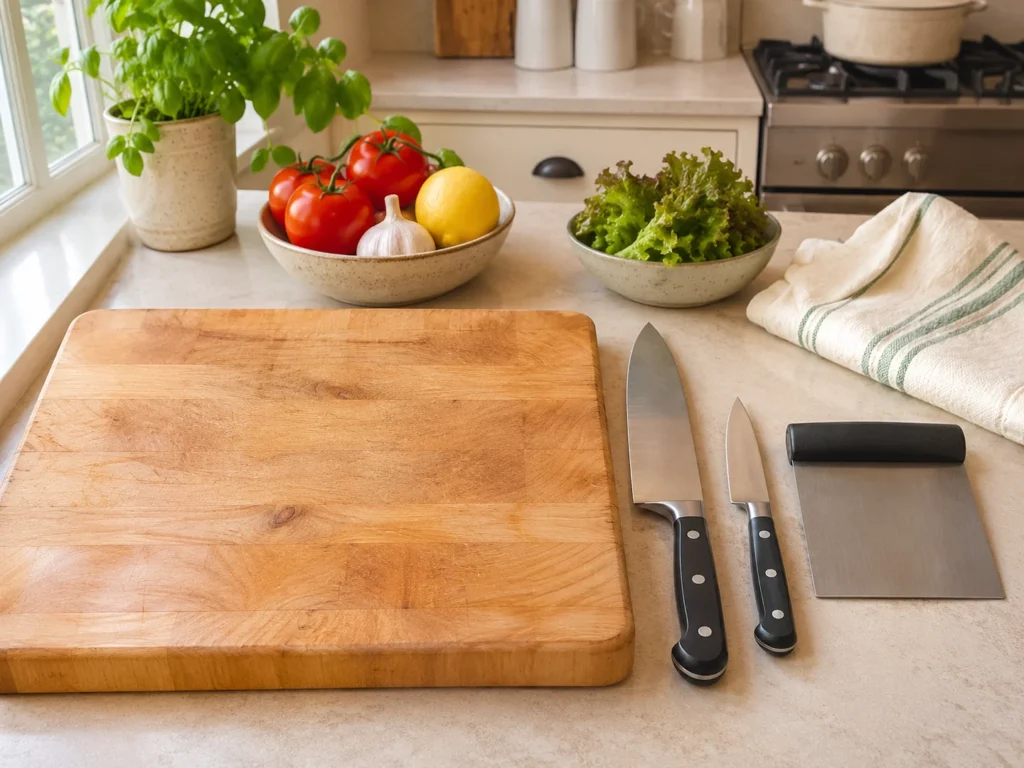
- A stable chopping board with room around it
- A clean non-slip mat or lightly damp cloth for beneath the board
- A sharp chef’s knife that feels comfortable in your hand
- A small paring knife, optional
- A bench scraper
- Two bowls: one for prepared food and one for trimmings
- A clean towel
Ingredients for the practice
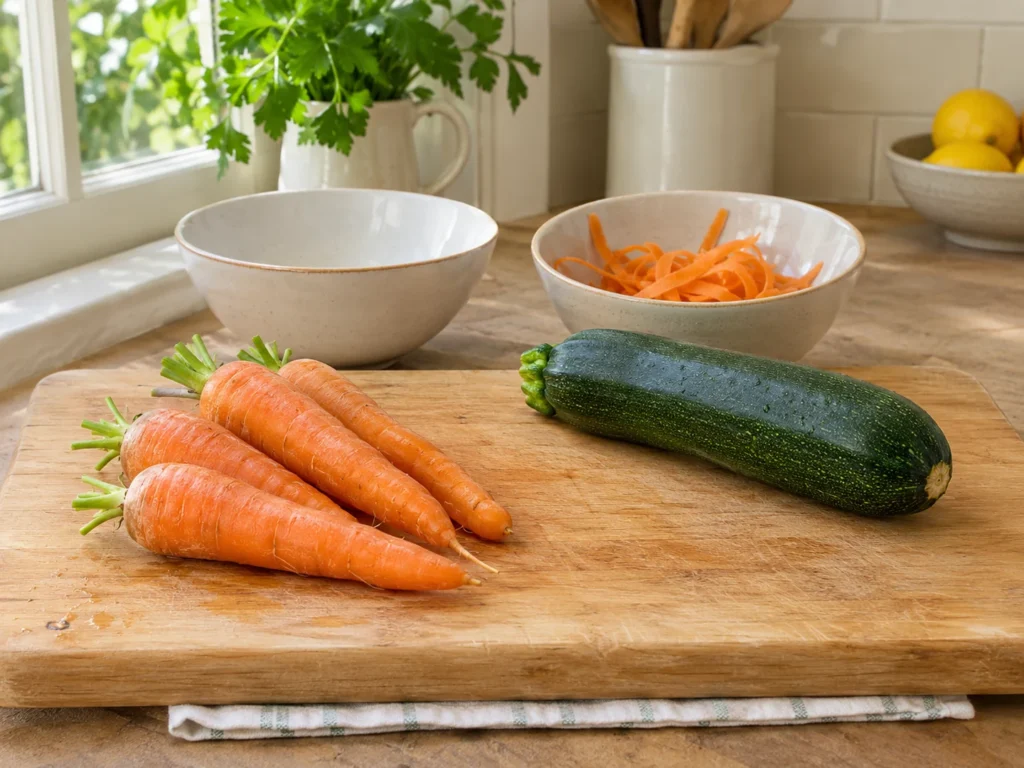
- 2 medium carrots, approximately 200 g total
- 1 medium courgette, approximately 200 g
- A small handful of fresh parsley or basil
- Cold running water for washing the produce
1. Make the board dependable
Wash your hands, rinse the produce and dry it. Clear enough counter space to stand squarely in front of the board without reaching across clutter. If the board slides, put a clean non-slip mat or lightly damp cloth underneath it. Press gently at its corners before picking up the knife; it should stay where you put it.
Set one bowl for finished cuts and another for scraps within easy reach. Keep the knife at the back of the board when resting, with the cutting edge facing away from your working hand. A small board overflowing with vegetables is not a useful test of skill. Prepare one item at a time and move finished pieces out of the cutting area.
2. Match the knife to the work
Use a chef’s knife for the carrot and courgette. Choose a blade and handle you can control comfortably rather than the largest knife available. A paring knife suits small trimming jobs; a serrated knife is better for bread. Do not use a fine slicing knife to split bones or force a chef’s knife through frozen food.
A maintained edge should begin the cut without excessive pressure. If the blade slides on a carrot skin or crushes ingredients, stop and address its condition. Sharpen with an appropriate system or have it sharpened professionally. Honing and sharpening are different operations, so follow the instructions for your particular knife rather than improvising with a rod.
3. Find a steady knife-hand grip
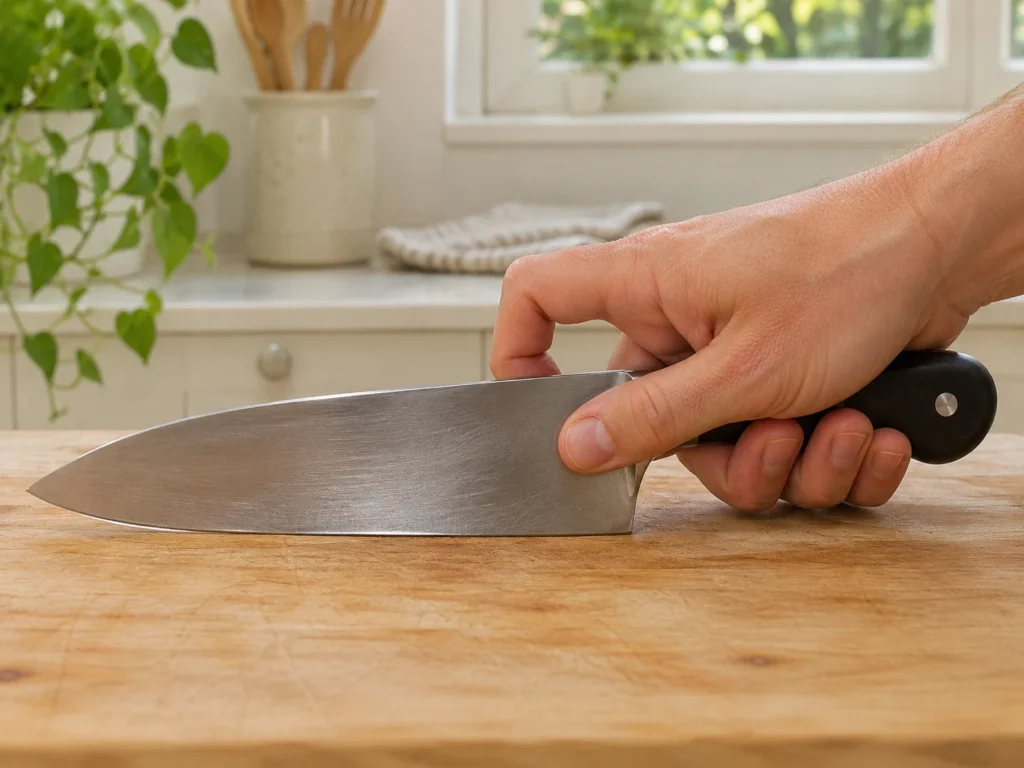
Try placing your thumb and index finger on opposite sides of the blade immediately in front of the handle, then wrap your remaining three fingers around the handle. This pinch grip gives many cooks a useful sense of control. Keep both fingers on the broad faces, well above the sharp edge. If another secure grip suits the knife and your hand better, use it.
Relax your shoulders and keep your wrist close to neutral. Hold firmly enough to direct the blade without clenching. Start with the knife resting on the board, then rehearse a slow forward-and-down movement without food. Never hold a vegetable in your palm while practising the large-knife cuts in this lesson.
4. Curl the guiding fingers
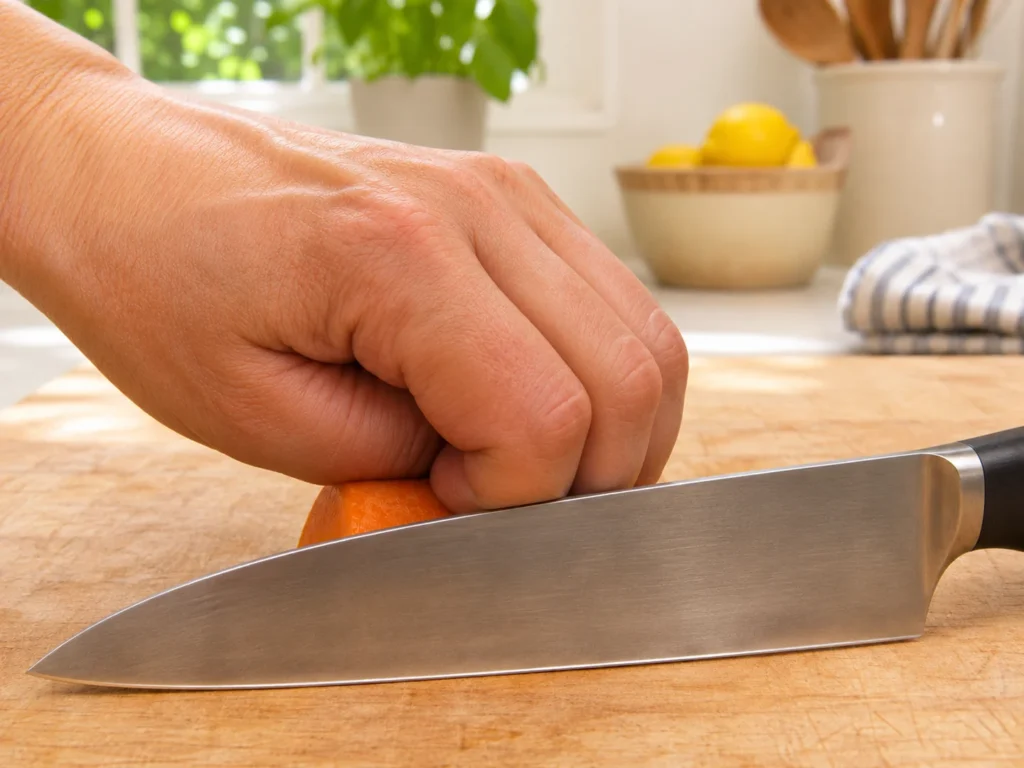
Place your free hand on the vegetable with fingertips curled inward and the thumb tucked behind them. The front knuckles can help guide the side of the blade while the fingertips remain out of its path. Keep the fingers comfortably bent, rather than forcing an exaggerated claw that is difficult to maintain.
Move this hand back in small increments between cuts. The knife should travel where you intend without needing to chase the vegetable. If the last piece becomes too small to hold securely, stop; turn it to a stable face or leave that end for a different use. Sacrificing a tiny trimming is preferable to continuing an awkward cut.
5. Give round ingredients a flat face
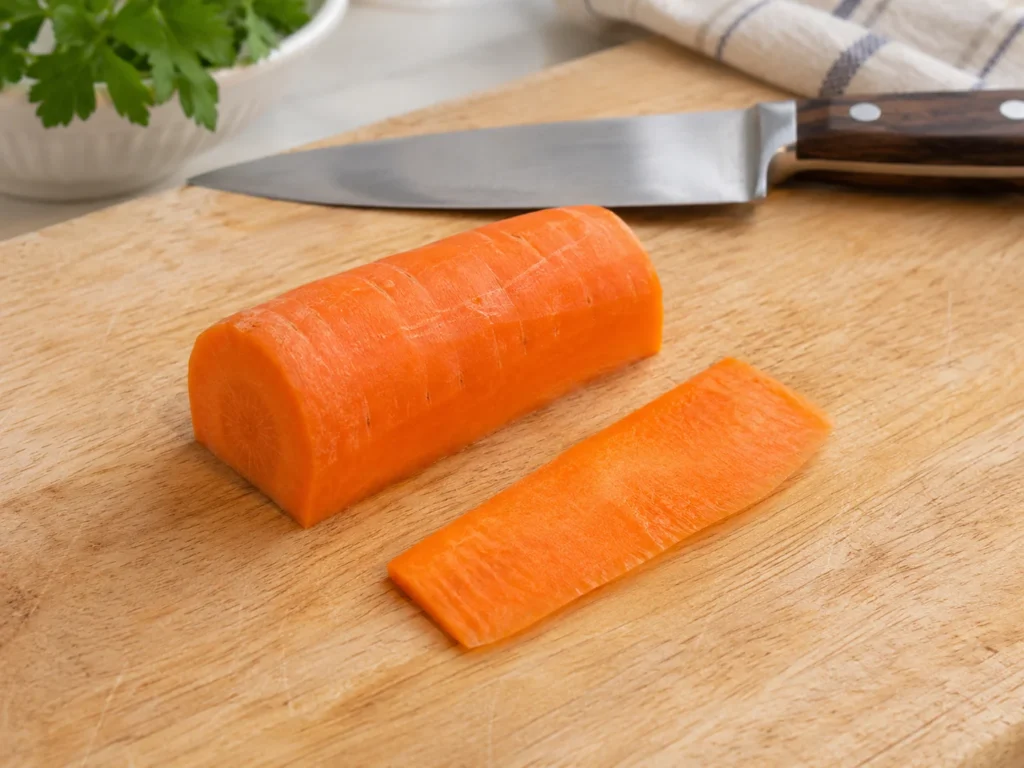
Trim the carrot’s ends. For a long carrot, cut it crossways into manageable sections around 5 cm long. Make a controlled lengthways cut to create a flat face, then lay that face against the board. A cylindrical ingredient that rolls under the blade needs resetting before you continue.
Use the same approach for the courgette: trim, halve it crossways if needed, and split each section lengthways. Place the flat side down. Notice how much less effort is needed to hold it still. Keep the ingredient close enough to your body to control, while leaving room for the blade to travel without reaching the counter’s edge.
6. Progress from slices to batons to dice
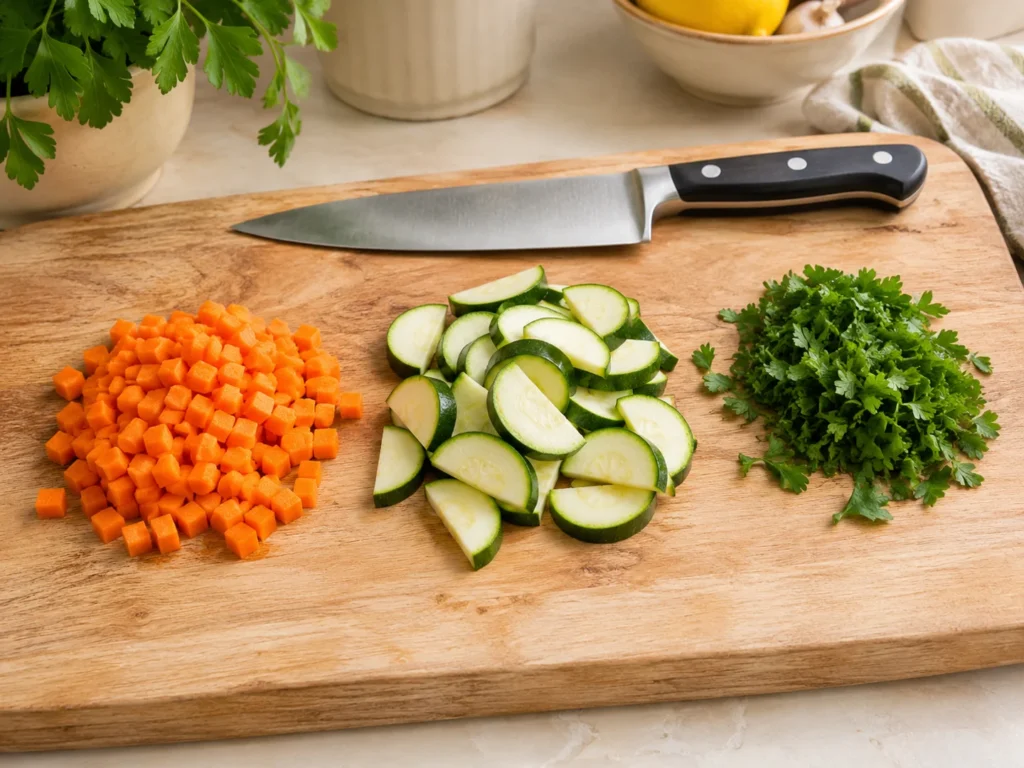
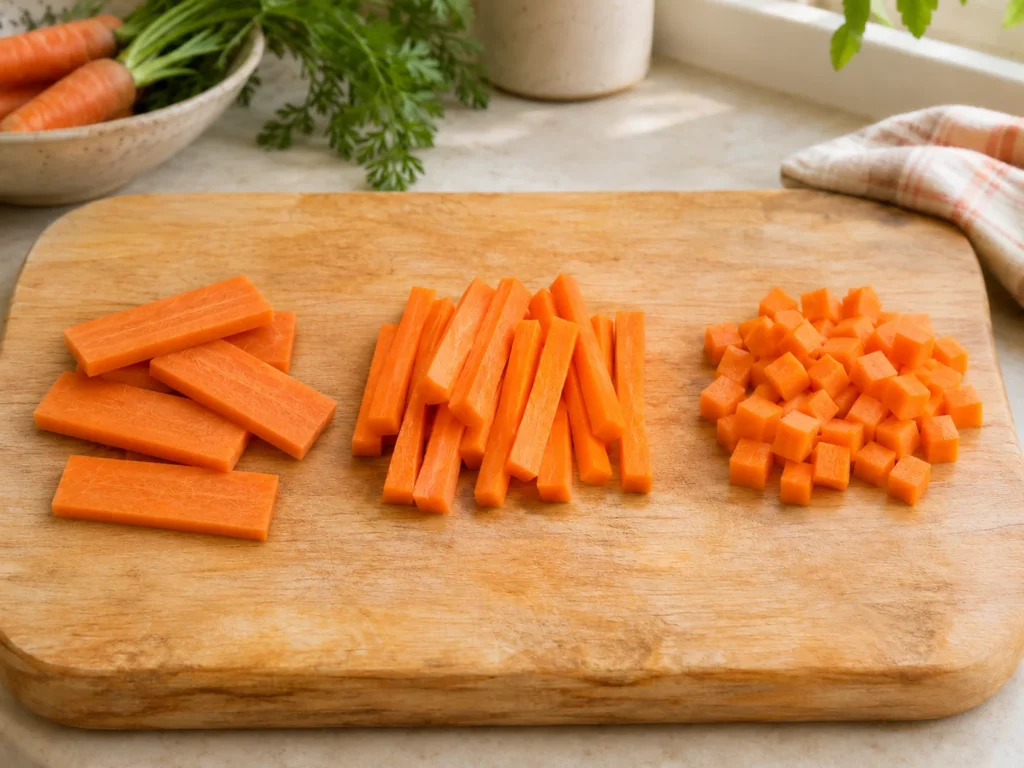
Cut the stable carrot sections lengthways into slices about 5 mm thick. Lay one or two slices flat, cut them into strips about 5 mm wide, then turn those strips and cut across at roughly 5 mm intervals. You have made small dice suitable for a quick-cooking soup or sauce base. Keep stacks low; a tall stack can slip.
For the courgette, practise half-moons about 5 mm thick instead. Use a smooth cut rather than pressing straight down with force. Different blades favour slightly different movements, so let the shape of your knife guide you. Similar thickness matters more than mathematical perfection. Do not mix very fine dice with large chunks if the whole batch needs to soften together.
7. Chop herbs without chasing them
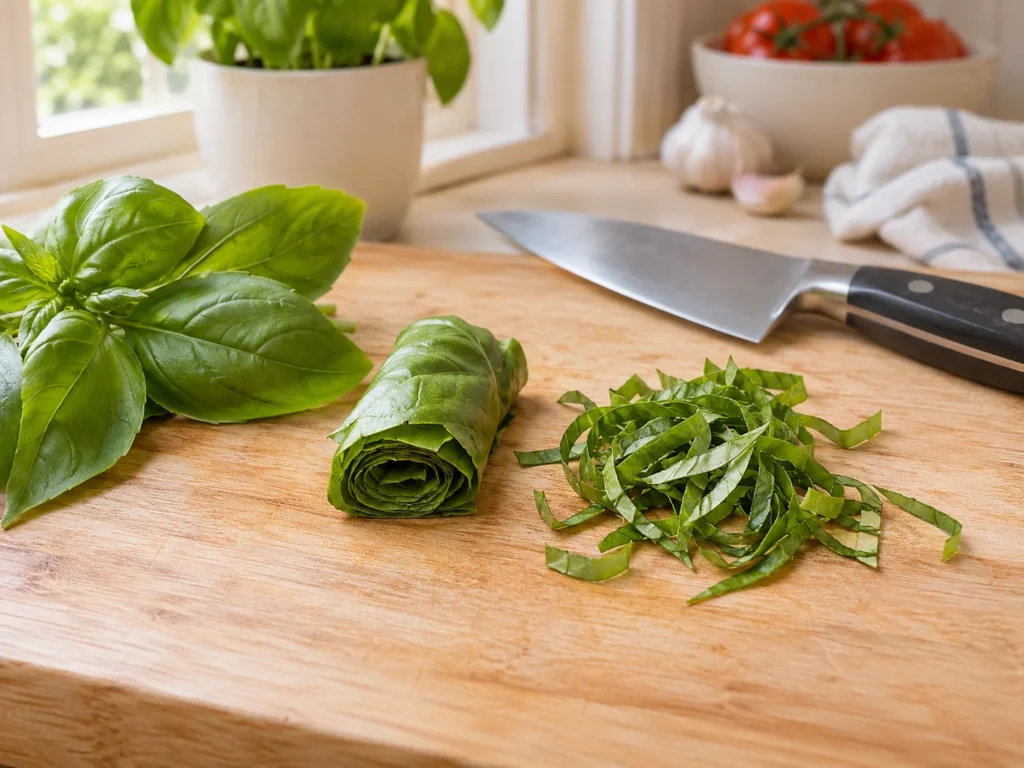
Remove tough stems and dry the leaves well. Gather the parsley or basil into a small loose pile. Make several controlled cuts across it, regrouping with the knife put down whenever necessary. For basil ribbons, loosely stack a few leaves, roll them gently and slice across; keep the roll small enough to hold safely.
Stop once the pieces suit the dish. Repeatedly working a damp pile can bruise the leaves and leave more flavour and colour on the board than you wanted. Move prepared food with a bench scraper. If using the knife as a scoop, keep your other hand away from the edge and avoid dragging that sharp edge across the board.
8. Clean, store and practise deliberately
Put the knife down before answering someone or reaching for a dropped item. Never try to catch a falling knife, and never hide one in a sink of water. Wash carefully according to the manufacturer’s directions, dry it promptly and store the edge protected in a suitable sheath, block or secure rack.
Keep equipment used for raw meat, poultry or fish separate from ready-to-eat produce, or wash it thoroughly with hot, soapy water before changing tasks. Refrigerate the prepared vegetables promptly if you are not cooking now. The carrots can go into a soup; the courgette can be sautéed separately. Using the results turns a short practice session into useful preparation.
When it does not go to plan
The food keeps rolling. Stop and create a flat surface. Do not try to compensate by gripping harder beside the blade.
The blade needs a lot of pressure. Check sharpness, knife suitability and food stability. Never push through a cut that feels uncontrolled.
The pieces are uneven. Slow down, keep the guiding hand movement small, and practise a single thickness before changing shapes.
Put it into practice
Spend ten unhurried minutes making carrot dice and courgette half-moons. Compare five pieces from each group, then cook the vegetables separately and notice whether the pieces reach tenderness together. Repeat with the same knife and board before trying speed.